
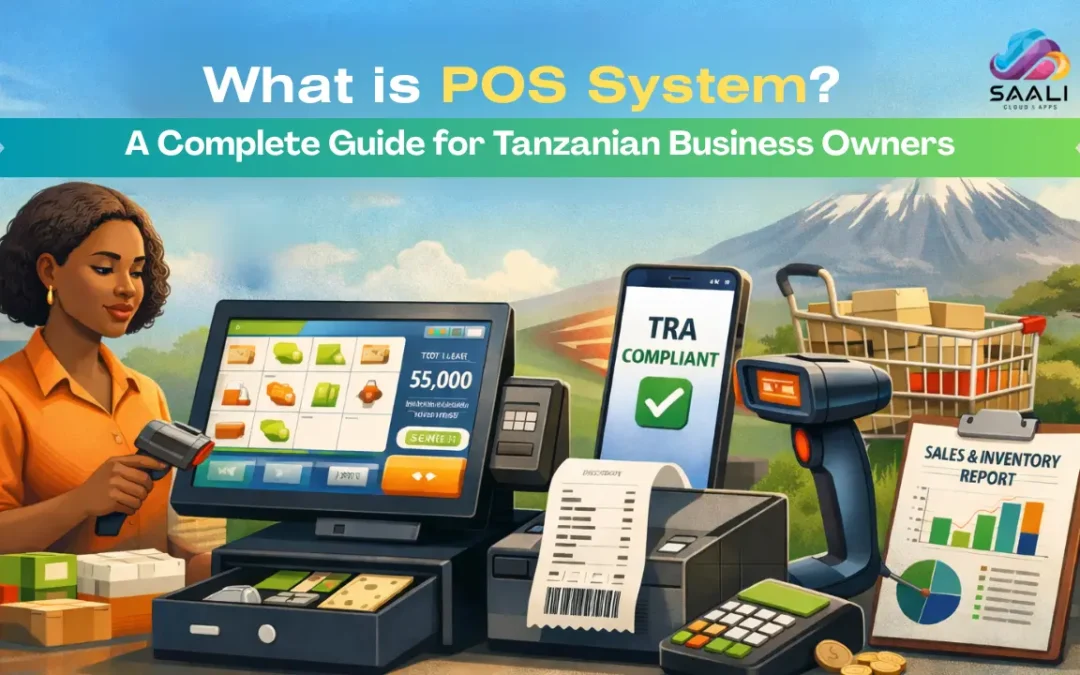
Many Tanzanian businesses struggle with slow billing, stock losses, and poor reporting. A POS system solves these problems by digitising sales and inventory. This guide explains what a POS system is, why Tanzanian businesses need it, and why Saali POS is the best local solution.
What is a POS System?
A POS system, short for Point of Sale system, is a business management software that records sales transactions when a customer buys a product or service. However, modern POS systems go far beyond simple billing. They manage sales, inventory, customers, payments, staff activity, and reports from one central system.
In a Tanzanian business environment, a POS system replaces manual receipt books, Excel sheets, and disconnected tools. When a sale is made, the POS automatically updates stock levels, records the payment method, applies tax rules, and stores the transaction securely. This ensures accuracy and transparency across the business.
What does POS System Include?
From a technical perspective, a POS system consists of software (the system itself) and optional hardware (billing screen, receipt printer, barcode scanner). The software is the most important part because it controls how data is recorded, processed, stored, and reported. Saali POS uses a secure, cloud-enabled architecture, ensuring business data is safe, accessible, and reliable.
Why Do Tanzanian Businesses Need a POS System?
1. Faster Billing and Checkout
Manual billing slows down sales and increases customer waiting time. A POS system processes transactions instantly, improves checkout speed, and creates a better customer experience, especially in busy Tanzanian retail environments.
2. Accurate Stock Control
Many businesses lose money due to unknown stock shortages. A POS system tracks inventory in real time, helping Tanzanian business owners avoid overstocking, stockouts, and losses.
3. Better Financial Visibility
Without proper systems, owners do not know daily sales or profits. POS software provides clear sales reports, helping businesses understand performance instantly.
4. TRA and Tax Readiness
Tax compliance is critical in Tanzania. A POS system supports structured transaction records and EFD/VFD requirements, reducing the risk of penalties.
What Problems Does a POS System Solve?
1. Manual Errors
Handwritten bills and spreadsheets cause mistakes. A POS system reduces human error by automating calculations and data entry.
2. Stock Loss and Theft
Without tracking, stock can disappear unnoticed. POS systems log every sale and adjustment, improving accountability.
3. Slow Reporting
Manual reporting takes hours or days. POS systems generate real-time sales and inventory reports instantly.
4. Cash Handling Issues
POS systems track every payment, reducing cash mismatches and improving transparency.
5. Poor Business Control
Owners lose control without data. POS systems give complete visibility over sales, staff, and inventory.
Who Should Use a POS System in Tanzania?
1. Retail Shops and Mini-Marts: Retailers benefit from faster billing, accurate stock control, and daily sales visibility.
2. Supermarkets: High-volume businesses need POS systems to manage fast-moving goods, suppliers, and daily reports.
3. Pharmacies: POS systems track batch numbers, expiry dates, and medicine stock accurately.
4. Hardware and Wholesale Stores: Managing thousands of SKUs manually is risky. POS systems simplify bulk inventory and supplier management.
5. Petrol Stations and Logistics: POS systems help monitor fuel sales, invoices, and daily transactions securely.
How Is POS Different from Manual Billing?
| Feature | Manual Billing | POS System (Saali POS) |
| Billing Speed | Slow | Fast and automated |
| Error Risk | High | Very low |
| Stock Tracking | Manual guessing | Real-time updates |
| Reporting | Time-consuming | Instant reports |
| Compliance | Risky | TRA / EFD ready |
| Scalability | Limited | Easily scalable |
Manual billing may work temporarily for very small operations, but it becomes unreliable as soon as transaction volume increases. A POS system like Saali POS eliminates guesswork and provides structured, accurate control over business operations.
What Sets Saali POS Apart in Tanzania
1. Built Specifically for Tanzanian Businesses
Saali POS is not generic foreign software adapted later. It is designed around how Tanzanian businesses actually operate, local pricing structures, mobile money usage, TRA expectations, and daily retail realities. This makes implementation smoother and adoption faster across industries.
2. Full TRA / EFD / VFD Compliance
Tax compliance is not optional in Tanzania. Saali POS aligns with TRA requirements by maintaining transparent, traceable transaction records. Every sale is logged correctly, reducing audit risks and helping businesses stay compliant without complex manual processes.
3. True All-in-One Business Management
Unlike basic POS tools that only bill, Saali POS combines sales, inventory, suppliers, customers, employees, payments, and reports into one platform. Business owners do not need multiple systems, reducing cost, confusion, and operational gaps.
4. Cloud-Enabled With Secure Local Access
Saali POS uses secure cloud technology to protect business data while allowing access anytime, anywhere. This is critical for owners managing multiple branches or travelling, while still keeping data safe from loss, theft, or system failure.
5. Scalable for Growth Without System Change
Many Tanzanian businesses outgrow their first POS system quickly. Saali POS scales easily, new branches, warehouses, users, and products can be added without changing software, ensuring long-term value and continuity.
How to Choose the Right POS System in Tanzania
Choosing the right POS system is not about price alone. Tanzanian businesses should evaluate whether the system supports TRA compliance, handles mobile money payments, manages inventory accurately, and scales as the business grows. Ease of use is equally important; staff should learn the system quickly without long training periods.
Saali POS meets these criteria by offering simplicity, compliance, scalability, and strong local support, making it a practical long-term choice rather than a temporary solution.
What Are the Common POS Mistakes Businesses Should Avoid?
1. Choosing Price Over Functionality
Cheap POS systems often lack compliance, reporting, or scalability, leading to replacement costs later.
2. Ignoring Tax Compliance Requirements
Using non-compliant systems exposes businesses to penalties and audit risks.
3. No Inventory Tracking Setup
Without proper stock configuration, businesses still suffer losses despite having POS software.
4. Lack of Staff Training
Untrained staff misuse systems, causing errors and inaccurate data.
5. Using Non-Scalable Systems
Systems that cannot grow with the business force costly migrations later.
Is POS Worth It for Small Businesses in Tanzania?
Yes, a POS system is especially valuable for small businesses. Manual systems hide losses, errors, and missed opportunities. Saali POS helps small shops, mini-marts, and startups gain control from day one, tracking sales, managing stock, and preparing for growth without complexity. The return on investment comes quickly through improved accuracy, faster billing, and better decision-making.
Try Saali POS Today
If you want faster billing, accurate stock control, and full visibility into your business, Saali POS is the solution built for Tanzania. Manage sales, inventory, customers, and compliance from one system. Start working smarter, try Saali POS today and take control of your business operations with confidence.
Get in touch with us for a demo
- Email Address: info@amd.co.tz
- Phone Number: +255 789 874 466
Conclusion
A POS system is no longer optional for Tanzanian businesses aiming for efficiency, compliance, and growth. From reducing manual errors to improving customer service and meeting TRA requirements, the right POS system transforms daily operations. Saali POS stands out by combining local expertise, compliance readiness, scalability, and ease of use, making it the most reliable choice for businesses across Tanzania.
FAQs
Q1. Can Saali POS be used offline?
Yes, core operations can continue locally, with data syncing securely when connected.
Q2. Does Saali POS support mobile money payments?
Yes, it supports cash, card, and mobile money payment methods.
Q3. Can Saali POS handle multiple branches?
Yes, it supports multi-branch and multi-warehouse operations.
Q4. Is Saali POS suitable for non-retail businesses?
Yes, it is used by logistics, petrol stations, wholesalers, and service businesses.
Q5. How long does implementation take?
Implementation is fast, depending on business size and data requirements.