
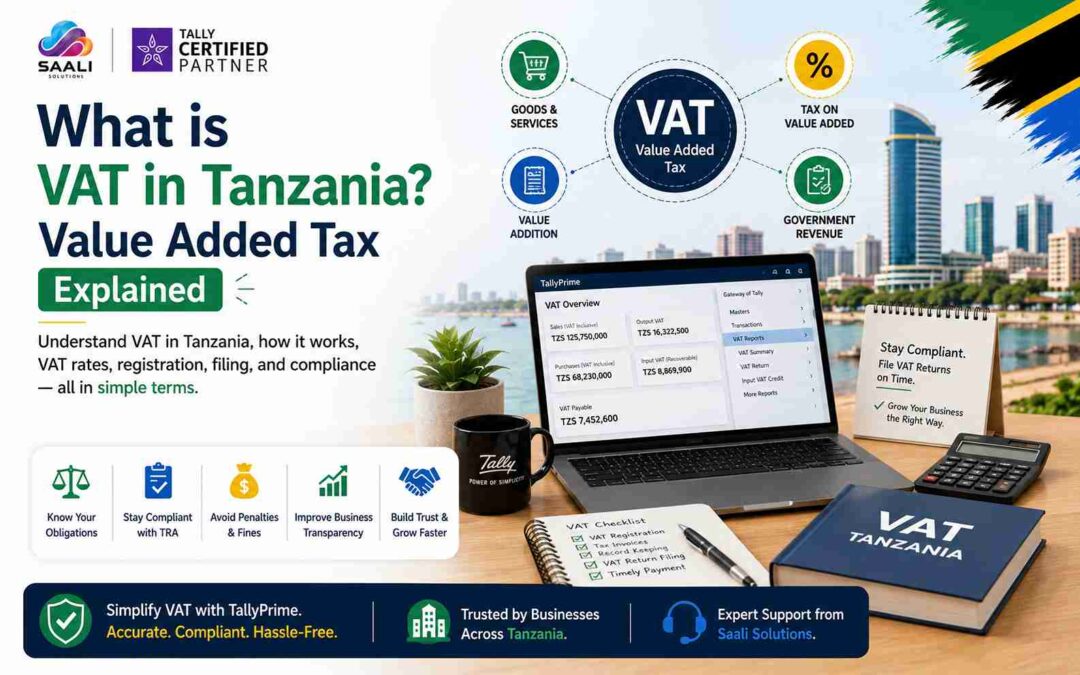
VAT is among the most significant business taxes in Tanzania. VAT is the tax that is charged to the price of any taxable product or service at all stages of its production and sale, but it ends up being paid by the end consumer of the product or service.
VAT in Tanzania
- VAT refers to Value Added Tax, which is a tax levied on the addition of value to taxable goods, taxable services, or qualifying immovable property whenever this happens in Mainland Tanzania.
- VAT can only be charged by VAT-registered businesses. Any business that is not registered for VAT cannot levy VAT on its sales.
- VAT applies through all stages of the supply chain starting from the manufacturing stage, the importing stage, through to the wholesaling and retailing stages until products and services are supplied to the end user.
- Though VAT is collected by businesses, it is finally paid by consumers, and as such VAT is classified as an indirect tax.
- VAT applies to locally supplied products as well as imported products but not to exports.
Why is VAT Important for Businesses in Tanzania?
Compliance
Businesses that are VAT registered must comply with the requirements under the VAT Act and TRA by ensuring issuance of tax invoices in accordance with the prescribed rules and regulations, keeping records and submitting VAT returns. Compliance will reduce regulatory risks to a great extent.
Penalty Avoidance
Non-compliance in terms of registering where registration is mandatory, charging VAT improperly, submission of VAT returns, and payments past due dates may lead to imposition of penalties. Early compliance enables businesses to set up proper accounting systems in order to avoid mistakes in the future.
Customer Satisfaction
VAT-registered businesses that provide invoices properly show professionalism in their work and also that they comply with the regulations. Companies and other institutions usually prefer working with those companies that can provide them with VAT invoices.
Tax Filing Simplification
If businesses have maintained organised records on VAT transactions throughout the month, the process of filing VAT returns becomes easier. The businesses do not have to check individual transactions for VAT purposes.
How Does VAT Work in Tanzania?
Value Added Tax is collected through taxation of value addition at each stage of production. Each registered business is charged VAT on its taxable supplies known as Output VAT. The registered business pays VAT on its eligible purchases as Input VAT. This tax is then submitted by the business to the Tanzania Revenue Authority as the balance between the Input VAT and Output VAT.
Step 1 – Manufacturer Adds Value
This involves the purchase of raw materials from which the manufacturer produces finished goods. The VAT paid for the purchases becomes the input VAT and the VAT charged during the sale of the finished goods becomes output VAT. Value addition by the manufacturer is therefore taxed.
Step 2 – Wholesaler Purchases Goods
In this step, VAT is paid by the wholesaler when buying goods from the manufacturer. This VAT becomes input VAT and when selling the same to retailers, output VAT is charged by the wholesaler.
Step 3 – Sale by the Retailer to the Consumer
The retailer buys goods from the wholesaler and claims the input VAT. Upon sale of these goods to consumers, output VAT is charged. The VAT due will be calculated by subtracting the input VAT from the total output VAT.
Step 4 – Consumption by the Final Consumer
Since the final consumer does not engage in business activities, there is no input VAT to claim, and therefore the consumer cannot get back any VAT. Ultimately, despite the VAT being collected at different stages, the final consumer bears the burden of paying VAT.
Illustrative Example
| Stage | Selling Price (Excluding VAT) | VAT Charged | Input VAT | Output VAT | VAT Payable to TRA |
| Manufacturer | TZS 1,000,000 | TZS 180,000 | TZS 90,000 | TZS 180,000 | TZS 90,000 |
| Wholesaler | TZS 1,500,000 | TZS 270,000 | TZS 180,000 | TZS 270,000 | TZS 90,000 |
| Retailer | TZS 2,000,000 | TZS 360,000 | TZS 270,000 | TZS 360,000 | TZS 90,000 |
| Final Consumer | Pays Total Invoice | Cannot Claim VAT | Not Applicable | Not Applicable | VAT Burden Falls on Consumer |
Who Is Supposed to Be VAT Registered?
When a Business Reaches the Turnover Limit
A business has reached a point where VAT registration is required once it meets the turnover limit set by Tanzanian VAT legislation. It is important that a business nearing the limit keep checking its taxable turnover and start getting ready for registration before exceeding the limit.
Businesses Required by Law
In case the turnover does not necessarily require the person to register for VAT, the Commissioner General has powers to register a person provided the person satisfies the legal requirement or registration is necessary in order to safeguard government income. In this case, a business needs to consider both the turnover and legal requirements.
Intending Traders
People intending to carry out business operations are supposed to get registered for VAT before commencing business operations, provided they can offer enough evidence indicating their commercial intentions. Such evidence includes contracts, approved business plans, tenders, or funding arrangements.
Professional Service Providers
Professional service providers might be liable to registration depending on certain provisions that apply to them. Professional firms are advised to analyse their requirements in detail as the registration requirements will not be the same as those for normal business turnovers.
Government Entities Carrying Out Economic Activities
The government institutions or organisations that engage in taxable economic transactions may be liable to VAT registration depending on the provisions of the law. Their obligations will include VAT accounting, return filing, and documentation just like other taxable persons.
How to Register for VAT in Tanzania
Register for Taxpayer Portal Account
This involves accessing the TRA Taxpayer Portal website in order to complete the process. It is important to ensure that your taxpayer details are updated before commencing the registration.
Fill in the Online Registration Form
This involves filling in the VAT Registration form through the Taxpayer Portal. Ensure that all sections are correctly filled in since incomplete details may cause delays in the process.
Get Your Supporting Documents Ready
These may comprise identification documents, business registration details, business contracts, business plan, finance details or any other document that TRA requires from the applicant based on the circumstances of registration.
TRA Verification
TRA verifies the information that has been provided in order to assess whether the registration process has been met.
Get Your Registration Certificate
After being approved, the taxpayer is issued with a VAT Registration Certificate alongside the VAT Registration Number and the Taxpayer Identification Number for VAT transaction purposes.
Display the VAT Registration Certificate
It is mandatory for taxpayers to display the VAT Registration Certificate at their principal place of business.
What Are the Current VAT Rates in Tanzania?
| Transaction | VAT Rate | Practical Explanation |
| Taxable goods and services supplied in Mainland Tanzania | 18% | Standard VAT charged on most taxable business supplies. |
| Importation of taxable goods and services | 18% | VAT is generally collected through customs procedures on qualifying imports. |
| Certain electronic or bank payments by eligible non-VAT registered individuals | 16% | Reduced rate applies only where specific legal conditions are satisfied. |
| Export of qualifying goods and certain services | 0% | Zero-rated to encourage international trade while maintaining VAT compliance. |
| Goods supplied to VAT withholding agents | 15% | Supplier receives consideration after the prescribed withholding mechanism applies. |
| Services supplied to VAT withholding agents | 12% | Part of the VAT is withheld and remitted directly to TRA by the withholding agent. |
VAT Rate vs Zero-Rated vs Exempt Supplies
Many new business owners assume zero-rated and exempt supplies mean the same thing. They are different under Tanzanian VAT law and affect invoicing, VAT recovery and reporting differently.
| Category | VAT Charged | Input VAT Recovery | Example |
| Standard-rated | Yes | Generally allowed where eligible | Most taxable goods and services |
| Zero-rated | Charged at 0% | Generally allowed where eligible | Qualifying exports |
| Exempt | No | Generally not recoverable | Specific exempt supplies provided by law |
Taxable Supplies Explained
Goods
Taxable supplies of goods consist of physical items that are produced, imported, delivered or sold in Mainland Tanzania if such supplies are carried out during an economic activity which is covered by the provisions of VAT law.
Services
Professional services, consultancy services, repair services, transport, maintenance services and various commercial operations might be taxable supplies when they are supplied during economic activities by a taxable person.
Immovable Property
Certain operations relating to qualifying immovable property in the context of economic activities might become taxable supplies depending upon their nature and the provisions of the VAT laws.
Imports
Importation of taxable goods and services into Mainland Tanzania becomes taxable under the VAT laws through the ordinary process of customs clearance. Eligible firms can later get allowable input VAT from such transactions.
What is Input VAT?
Input VAT is defined as the Value Added Tax that a business registered for Value Added Tax pays when acquiring goods or services that are taxable under the Tanzanian VAT Act. Provided that certain conditions of the Tanzanian VAT Act are fulfilled, input VAT can be used for tax credits against output VAT in the tax period.
What is Output VAT?
The definition of Output VAT is the VAT imposed on the sale of taxable goods and services by a business registered under the Tanzanian VAT Act. This VAT is collected on behalf of the Tanzania Revenue Authority.
Input VAT vs Output VAT: Key Difference
| Comparison | Input VAT | Output VAT |
| Purpose | VAT paid on eligible business purchases | VAT charged on taxable sales |
| Who pays | Business purchasing goods or services | Customer buying goods or services |
| Who receives | Supplier collects the VAT | Selling business collects VAT |
| When recorded | At the time of eligible purchase | At the time of taxable sale |
| Claimable | Usually claimable where legal conditions are met | Not claimable because it is collected for TRA |
| Business impact | Reduces VAT payable where eligible | Increases VAT liability before deductions |
| Example | VAT paid on business inventory | VAT charged on customer invoices |
How is VAT Calculated?
VAT calculation follows a simple principle. First, calculate the output VAT collected from taxable sales. Then calculate the eligible input VAT paid on business purchases. Finally, subtract input VAT from output VAT. If output VAT exceeds input VAT, the difference is payable to the Tanzania Revenue Authority. If eligible input VAT exceeds output VAT, the business may qualify for a credit or refund under applicable VAT rules.
VAT Formula:
VAT Payable = Output VAT − Eligible Input VAT
VAT Calculation Examples:
| Business Type | Output VAT | Eligible Input VAT | VAT Payable |
| Retail Shop | TZS 900,000 | TZS 650,000 | TZS 250,000 |
| Service Business | TZS 540,000 | TZS 180,000 | TZS 360,000 |
| Wholesaler | TZS 1,260,000 | TZS 980,000 | TZS 280,000 |
Example VAT Invoice Calculation
| Description | Amount (TZS) |
| Selling Price Before VAT | 2,000,000 |
| VAT at 18% | 360,000 |
| Total Customer Invoice | 2,360,000 |
If the business has already paid TZS 250,000 as eligible input VAT during the same tax period, the VAT payable to TRA will be:
Output VAT: TZS 360,000
Less Eligible Input VAT: TZS 250,000
VAT Payable: TZS 110,000
This calculation demonstrates that businesses do not pay VAT on the full selling value. Instead, they account only for the tax relating to the value added during their own stage of business operations.
What is a VAT Return?
A VAT return refers to an officially required form filled out by all VAT-registered businesses to the Tanzania Revenue Authority. In addition, it shows the taxable sales, allowable business purchases, output VAT received, allowable input VAT paid and the VAT liability for that period. The VAT returns can be filed electronically using the TRA Taxpayer Portal.
Monthly Tax Declaration
All VAT-registered businesses file a monthly VAT return to keep their taxable transactions and VAT computation and recordkeeping process accurate.
Reports Business Transactions
VAT return provides a summary of taxable sales, purchases, output VAT, allowable input VAT, adjustments, and the net VAT liability for that month.
Mandatory Legal Requirement
The filing of VAT returns is mandatory by law even where there are no taxable sales in the period that requires a nil return.
Filing Deadline Matters
Businesses need to file VAT returns within the statutory deadline due to possible consequences of delays.
VAT Refund Explained
A VAT refund occurs in situations where a taxable person’s input VAT is more than his output VAT or in case of an overpayment after deduction of the allowable amounts. Eligible persons apply for a refund by adhering to the prescribed procedure from TRA and providing necessary supporting documentation.
When Refunds Apply
These occur when allowable input VAT is more than output VAT or when there is an overpayment of VAT in a given accounting period.
Eligibility Requirements
The applicant must be able to fulfil all statutory VAT requirements, maintain proper accounting records and provide supporting documentation for each application for refund.
Required Supporting Documents
The supporting documentation includes refund calculations, certification by the auditors, prescribed checklist, tax invoices and other relevant information provided by the Commissioner General.
Refund Processing Timeline
TRA evaluates the refund applications based on information provided and makes a decision within the prescribed statutory period.
VAT Relief in Tanzania
There can be VAT relief only when it is provided for in the legislation of the country in particular circumstances. Mostly, the VAT relief is provided to investors and government initiatives which have been granted approval and which are of strategic importance.
Export Processing Zone Investors
The investors of the Export Processing Zones (EPZ) can be entitled to VAT relief when their investments meet certain criteria and approval conditions provided for in the relevant legislation.
Special Economic Zone Investors
The companies which are registered as special economic zone companies may be entitled to VAT relief for their activities, thus encouraging investments, manufacturing, exports and economic development.
Mining Oil and Gas Projects
The mining, oil and gas enterprises which entered into binding agreements with the government providing for some tax incentives are entitled to VAT relief.
Strategic Investment Projects
Some strategic investment projects which have been approved by the relevant legislation may be entitled to some VAT exemptions, especially in order to promote infrastructure and industrial development and economic growth.
Government Funded Projects
Government-funded projects and donor-funded projects approved by relevant agreements may be entitled to VAT relief.
Exemptions From VAT
VAT exemption entails the absence of VAT from specified qualifying supplies as per the Tanzania tax laws. Contrary to zero-rated supplies, exempt supplies do not permit the reclaiming of input VAT in relation to their acquisition.
Government Approved Supplies
Some supplies to Government bodies that meet some criteria can be exempt from VAT provided they are exempted by funding arrangements.
Projects Funded By Donors
Where the qualifying projects are funded by donors, and there are funding agreements which specifically include the VAT exemption clauses as per Tanzanian tax laws, then such projects shall be exempted from VAT.
Disaster Relief Supplies
Imports and supply of goods/services used only for recognised disaster relief purposes can be exempt from VAT if they have been approved accordingly.
Agreements In Strategic Projects
Those businesses that are undertaking approved strategic projects shall enjoy VAT exemptions where there are agreements with the government specifying the VAT relief.
Difference From Zero Rated
Zero-rated supplies are subject to VAT of zero per cent, but they allow VAT input deductions. On the other hand, exempt supplies do not permit input VAT deductions.
VAT on Imports
In most instances, the VAT liability arises whenever taxable goods or services are brought into Mainland Tanzania. The VAT on imports is usually levied through customs procedures prior to clearing of goods. In cases where statutory requirements are met, a business entity can treat the VAT on imports as input VAT in its VAT returns for purposes of reducing its VAT liability.
Is There VAT on Export of Goods or Services from Tanzania?
Yes. Qualifying exports of goods and some services will usually be zero-rated and not exempt. In other words, the exporter will levy VAT on the export at zero per cent without being outside the VAT system. Provided that all statutory requirements have been met, the eligible business entity can keep on claiming the allowable input VAT in respect of exportation of goods/services.
Common VAT Mistakes Businesses Make
Failure to Provide Tax Invoices
Inadequate or failure to provide tax invoices can affect eligibility for input VAT refund or lead to poor document backup for verification processes.
Submission of VAT Returns After Due Dates
Late submission of VAT returns exposes businesses to risks of non-compliance and possible statutory penalties and interest accumulation as per TRA.
Calculation Errors
Incorrect rates of VAT and calculation methods will affect the accuracy of the return.
Failure to Claim Input VAT Refund
Some businesses fail to make input VAT refunds due to failure to provide relevant invoices, customs or accounting documents during filing of VAT.
Poor Accounting Records
Poor record-keeping will make it difficult to reconcile and may cause errors during the reporting process.
Late Registration
Registration after the threshold is likely to attract retroactive assessment and penalty.
What is the Best VAT Compliant Accounting Software for Tanzania?
In case you are looking for a reliable software that will help your business to comply with VAT in a hassle-free way, then TallyPrime is one of the best software available in the market for businesses in Tanzania.
TallyPrime helps with VAT calculation, tax reporting, invoicing, stock management, and other financial record management. We at Saali Solutions are the authorized Tally Partner in Tanzania.
Contact us today for an official TallyPrime licence and support.
Conclusion
VAT knowledge in Tanzania is important for all entrepreneurs, accountants, and business owners. All the steps from registering to filing returns, claiming a refund, getting an exemption, and deregistering must be done accurately.
Those businesses that have good accounting practices, proper tax invoices, and knowledge on calculating input VAT and output VAT are likely to avoid being fined and manage finances more efficiently. As your business expands, it is advisable to embrace appropriate accounting practices and VAT software.
Read More: How to Generate VAT Reports in TallyPrime for Tanzanian Businesses
TallyPrime Explained: Features, Benefits & Use Cases for Tanzanian Businesses
Frequently Asked Questions About VAT in Tanzania
Is it possible to voluntarily register for VAT before achieving the threshold?
Yes, intended traders who have adequate documents such as contracts or business plans can register for VAT even before conducting taxable business operations.
Is it necessary to maintain VAT documents after filing?
Yes, companies must ensure that they preserve their tax invoices and supporting documents in case they are needed in the future.
Is it possible for the same company to have multiple users accessing its accounting software?
Yes, most contemporary accounting programs enable controlled access by multiple users to conduct authorized accounting operations.
Does VAT registration mean all products are subject to VAT?
No, depending on the type of supply, it is subject to VAT legislation in Tanzania as either taxable, zero-rated, or exempted supplies.
Why is it important for companies to audit VAT reports?
Auditing VAT reports allows them to notice any missing invoices or any miscalculations before filing reports.