
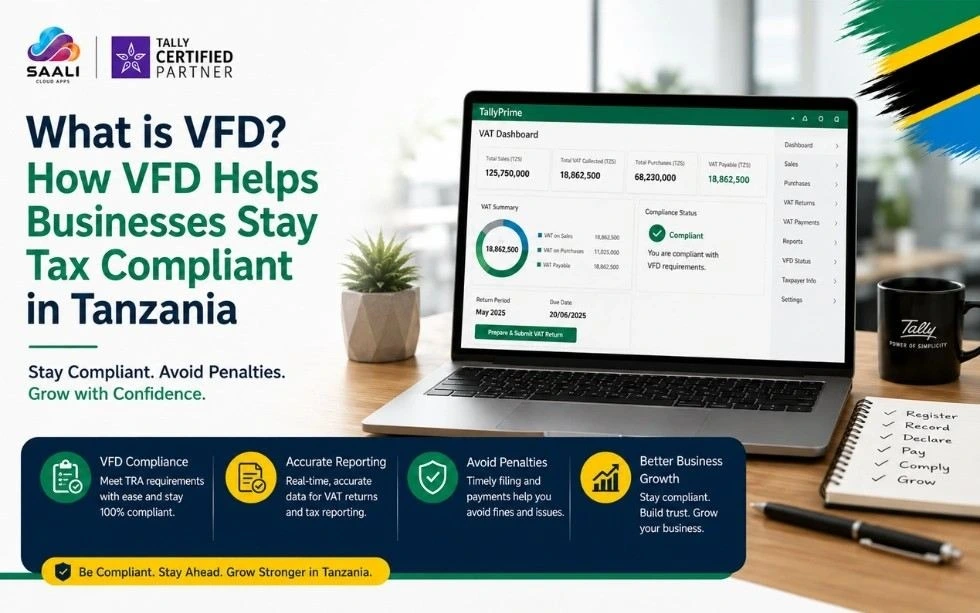
Companies in Tanzania are increasingly adopting digital invoicing and integrating their finance systems. This process includes the adoption of such technologies as the Virtual Fiscal Device, which is widely referred to as VFD.
For companies, learning about VFD is just the beginning. They need to understand how VFD integrates into their daily invoicing, financial management, and taxes. This is where the Tally software and a Tally Partner in Tanzania come into play.
What is VFD?
The term VFD refers to Virtual Fiscal Device. It is a digital solution that helps in the creation and management of electronic fiscal documents without having an actual Electronic Fiscal Device.
In simpler terms, VFD helps in connecting the business software of a taxpayer with the fiscal system through the digital route so as to facilitate the exchange of invoice information.
In the case of Tanzania, VFD would help in creating a more digital workflow by becoming a part of the overall invoicing process where the sales are made within the business system, and then the invoice information is exchanged.
Why Was VFD Introduced in Tanzania?
VFD is consistent with the broader trend of modernizing financial data management and electronic invoicing in Tanzania.
The conventional system poses some operational difficulties. It might be necessary for companies to keep track of their sales, invoices, accounting data, and compliance data on separate platforms. The manual input of data could cause repetition and data errors.
The implementation of a digital fiscal system could make invoice information processing within the company easier.
The introduction of this system is not only about replacing an old system with another. It is equally about adopting a more integrated approach to handling invoices. It is therefore important for growing companies.
How Does VFD Work?
The process flow for VFD depends upon the communication between the taxpayer’s business system and the relevant fictionalisation system.
Typical process steps may include:
- Business prepares the sales invoice in its management or accounting system.
- Invoice details that are needed are transmitted through the connected VFD process.
- The invoice is validated.
- An acknowledgement is sent back to the connected business system.
- The final sales invoice contains the fiscal data as required, including validation details like a QR code.
The main benefit here is automation. The business does not have to take care of each step manually.
How is a VFD Activated?
Prior to the operation of a VFD by the business, it has to go through the proper registration and activation procedure.
Typically, the process starts with a request submitted via the respective Electronic Fiscal Device Management System. After the request is approved, business registration proceeds and account credentials are issued.
At this point, the business is ready for integration work to be done.
Activation is not the whole process, though. The software needs to be configured to make sure invoice information will flow smoothly across the entire business process.
That is why businesses need to take into account the technical capacity while choosing their Tally Partner in Tanzania.
How are Invoices Generated via VFD?
In cases where companies have integrated software, the generation of invoices can be incorporated into daily operations.
A sales transaction will first be recorded in the company’s system. The invoice data is then shared through the VFD process for verification. On receipt of the response, the invoice data is available in the company’s process.
This can help minimize duplication of work since the same transaction is not being recorded again in different systems.
For instance, a company might want the sales data, customer data, movement of inventories, and accounting to be integrated. This is when the choice of management software comes in handy.
A properly configured Tally setup can help companies manage their accounts in line with other business processes.
What Are the Requirements for VFD?
It is necessary for businesses to know about the documentation that is needed before the process of activation can start.
Documentation that is needed for the VFD requirements:
- Taxpayer Identification Number, or TIN
- VAT Registration Number or VRN certificate, where applicable
- Application letter
- Required account registration and activation details
Once the account and login details are obtained, the next crucial step will be integrating the system into the business system.
Businesses must not view the process of compliance and software installation as two different processes.
Is a Physical EFD Machine Required for VFD?
The one question that arises most often is whether there is still a need for the physical EFD machine for companies using VFD.
VFD is developed in such a way that it is a digital version of the system and can function without relying heavily on physical EFD equipment. This system can be accessed through proper internet-enabled devices.
It allows businesses to become more flexible in adopting digital invoicing solutions.
However, eliminating the physical equipment from the picture does not mean that there will no longer be any requirement for the right configuration of business processes.
Therefore, it is important to evaluate the technology and the capabilities of the implementation partner.
Looking for Professional Tally Support for Your Company?
We at Saali Solutions are the certified Tally partners in Tanzania who assist companies in implementing and managing Tally software by providing full-fledged support services. We will help you create an effective Tally solution by understanding your needs and providing all required assistance. Contact us today!
Conclusion
VFD is an essential technology that can pave the way for digital invoicing and a more digitally integrated fiscal process in Tanzania. It could assist in helping firms reduce their reliance on physical equipment, improve invoice processing and facilitate transaction management.
Those who intend to use TallyPrime should know that the software itself is not enough. The choice of the appropriate Tally Partner in Tanzania will be crucial.
Frequently Asked Questions
1. Can multiple business branches use one VFD setup?
This will depend on the nature of the business, registration process and the way each branch is configured within the respective fiscal and invoicing workflow.
2. What happens if internet connectivity is interrupted?
Businesses need to know how temporary interruptions in internet connectivity impact the transmission, verification and synchronization of invoices in their VFD and software workflow.
3. Can VFD work with existing business software?
Yes, if the software solution allows proper integration and enables the transfer of invoice information via VFD connection.
4. How can businesses correct an invoice after validation?
This will depend on the fiscal processes and whether the connected software and VFD can enable such modification.
5. Why should businesses choose an experienced Tally Partner?
An experienced Tally Partner will help align software configuration, business processes, integration processes, training and technical support properly.